From Keys to Strings: Sustainable ‘Shredding’
If you’ve watched movies and shows such as Luca, Cobra Kai, and Ford vs. Ferrari, or even seen performances by The Revivalists or Alanis Morissette, chances are you’ve heard or seen a guitar crafted by luthier Boot Arreola.
Arreola, a native El Pasoan, owns B.A. Ferguson, a handmade guitar company established in 2008. While his business is now based in South Carolina and boasts an impressive list of clientele, his journey began in El Paso with a childhood fascination for guitars and an apprenticeship under local guitar craftsman Barry Martin, owner of Frets and Necks Guitar Specialty.
“I had heard of him when I was about 12 or 13,” Arreola said. “And when I was 15, I had this guitar that had broken. My grandfather was really good at fixing things and after he looked at it, he suggested we should get someone else’s help. I remembered Barry because everyone would tell me about him. My grandfather took me over there and after five minutes of looking at Barry’s shop, I knew that this is what I wanted to do for the rest of my life.”
After visiting Martin’s shop, Arreola became determined to learn more about the craft of lutherie and repeatedly sought an opportunity to work alongside him.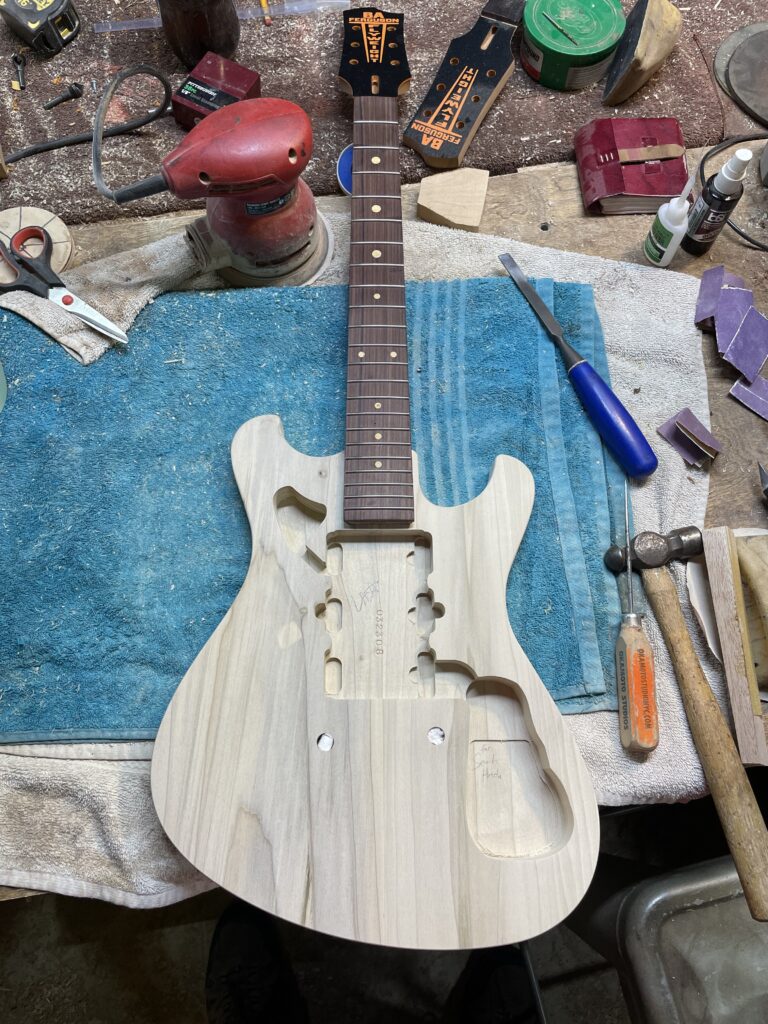
“I even asked him if I could work for him for free,” Arreola said. “He told me to go be a doctor or something else, and I was fairly stubborn, so I continued to go back. I would visit him for years and bring him guitar projects. By the time I got engaged, he offered me an apprenticeship.”
Following a two-year apprenticeship with Martin, Arreola decided to commit to guitar building full-time after getting married and learning he was going to become a father.
“It kind of came out of necessity,” he said. “My wife and I had been married almost a year and we had just found out we were pregnant. Between the two of us, we had almost five jobs. We knew the path we were on wasn’t sustainable unless we made some drastic changes, so we moved to South Carolina. It took a few years, but by the time 2008 came around, I had started the business during the housing bubble burst, and I thought to myself, ‘This is crazy.’”
Despite now living across the country, Arreola credits his El Paso roots for helping him persevere during difficult times.
“I was getting into the business full time and there was a recession happening,” he said. “But it was probably one of the best decisions I made because it allowed me to use the El Paso resourcefulness that I think we all have. We’re a culture where, in some ways, we’re forced to make do with very little and learn how to improvise.”
Part of what makes B.A. Ferguson unique is not only Arreola’s original designs, but also his commitment to sustainability. Rather than relying solely on newly harvested wood, he frequently repurposes materials from unwanted pianos.
“Wood is a living thing, even after you cut it,” he said. “It needs to twist and turn. One of the problems in the music industry today is that most companies can’t wait for wood to dry properly. I also wanted to be resourceful and use things that were going to be thrown away anyway. I started getting calls from people asking if I wanted old pianos because the other option was sending them to the dump. I wanted to use them because pianos contain beautiful wood that’s often around 100 years old.”
Over the years, Arreola has collected approximately 30 pianos and still has enough reclaimed wood from roughly 15 of them available for future projects.
“Sometimes we would just charge people gas money to go pick them up,” he said. “At the end of the day, on paper, it probably makes more sense to buy wood because it takes so much time to take apart a piano. But it’s worth it because we’re reclaiming this wood and giving it a new life.”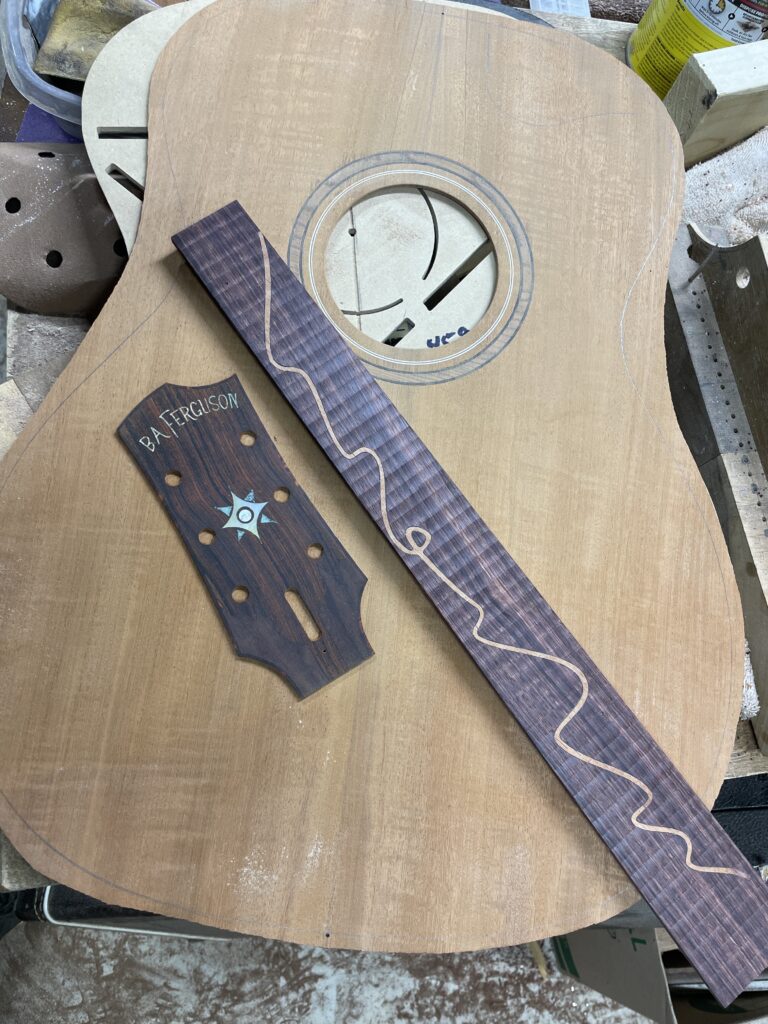
In addition to building guitars by hand, Arreola spends considerable time designing and modifying instruments to create unique, original models.
“I would work on some of the guitars that came in and ask Barry if I could trace them and modify them later on,” he said. “I worked on a lot of cool guitars from the ’60s and ’70s that were known as student-model guitars. They were cheaper guitars made for kids to learn on, and even though they weren’t great quality, you could upgrade them and make some amazing instruments.”
Arreola’s craftsmanship has attracted the attention of professional musicians, including Zach Feinberg of The Revivalists.
“Zach reached out to me as they were growing in popularity,” Arreola said. “He told me I had some guitars he’d like to try out and invited me to their show in Charlotte to see if we could strike a deal backstage. We hit it off and he loved the guitars. He picked one out and actually played it live that day. We later made another guitar for him, and as soon as he received it, he ended up playing it on The Stephen Colbert Show and Austin City Limits.”
His work has also been used by artists such as Andrew Synowiec, who has performed with Alanis Morissette and contributed to film soundtracks, as well as Mark Cimino of Shelter Dogs.
“These people made it in the industry,” Arreola said. “It means a whole lot because they recognize the value of my work, which allows me to value my own work a lot more.”
Today, Arreola produces approximately 50 guitars each year. In addition to selling directly through his website, his instruments are carried in 11 retail stores across the United States and internationally, including Strum PDX in Portland, Oregon; Coast Sonic in Carlsbad, California; Bangkok Music Exchange in Thailand; Kanda Shokai in Japan; and Axe And You Shall Receive in Canada.
“I started from literally nothing,” he said. “It’s one of those things where if you’re not working, there’s no money being generated. That gets hard, especially if you’re driven creatively, so you have to blend creativity with money-making. It’s not for the faint of heart, but it’s absolutely worth it, and it’s still all surreal for me.”
From repairing a broken guitar as a teenager in El Paso to building instruments played on television, in films, and on stages around the world, Arreola’s journey is proof that passion, persistence, and creativity can transform a childhood interest into a thriving career.