Ricardo Pepi Is Moving Forward
additional photos courtesy of Ricardo Pepi
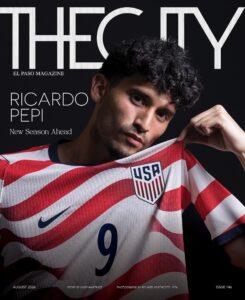
After carrying El Paso onto soccer’s biggest stage, the U.S. forward is learning how to appreciate the World Cup without losing sight of what comes next.
Ricardo Pepi is speaking by phone between training sessions in the Netherlands, where he is preparing for another season with PSV Eindhoven. The club’s season begins Aug. 2, leaving little time to linger over what he accomplished this summer. The World Cup is over, his brief window for rest has closed, and the 23-year-old forward is already thinking about the work required as part of the U.S. men’s national team.
“As an athlete, your life is going 100 miles per hour,” Pepi says. “Sometimes it’s difficult to sit down and soak it in.”
For Pepi, reflection required an intervention of sorts. He recently met with his agent and his father, Daniel, to look back at his club season and the World Cup. It gave him a chance to see his career through the eyes of the people who knew him before national team call-ups and European soccer.
His father, Pepi says, reached a point where he could hardly explain how happy he was.
“They had to sacrifice a lot of things,” Pepi says of his parents. “They were genuinely happy. It feels great to share that with people who have always supported you.”
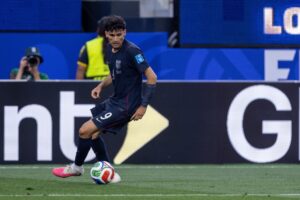
The World Cup fulfilled an ambition that had shaped nearly every part of Pepi’s young life. Yet he does not sound ready to build a shrine for the moment. He calls it a dream come true, then quickly turns toward what comes next.
“I’ve worked so hard my entire life,” he says. “It was amazing to share it with my family. At the same time, every single day, I’m just a person who wants to get the most out of every opportunity.”
That instinct, to appreciate the moment without becoming trapped inside it, has carried Pepi far from his home in the Borderland where his love for the game first began.
Born and raised in El Paso, Pepi is the son of Daniel and Annette Pepi, who emigrated from Mexico. He grew up watching matches with his father. Soccer was part of family life before it became a profession.
“Looking back, we were very middle class,” Pepi says. “My parents worked hard to give us a roof to live under. My parents never thought we’d make the World Cup. For me, it was the love of the game that got passed down by my father.”
Pepi attended Coronado High School before joining the FC Dallas academy. Major League Soccer led to Europe and eventually PSV. The environment changed, but the identity formed in El Paso remained present.
When people hear that he is from the Borderland, Pepi wants them to understand the character of the place before its location.
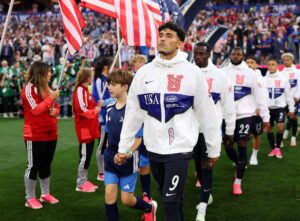
“I hope to represent El Paso people and Mexican American people in general,” he says. “We’re really humble and hardworking people. That is one of the things I’ve carried with me throughout my whole career. We have talent in El Paso.”
Pepi’s rise has made him evidence of that talent. He was called into the national team for the 2024 Concacaf Nations League Finals and selected for that summer’s Copa América roster. By April 2026, he had recorded 13 goals in 35 international appearances, placing him among the most prolific U.S. strikers of his generation.
Still, numbers cannot reproduce the feeling of walking onto a World Cup field. The 2026 World Cup was co-hosted by Canada, Mexico and the United States, bringing soccer’s largest tournament to North America for the first time in Pepi’s lifetime. For an El Pasoan raised along the Texas-Mexico border, where two of the host nations meet, the geography carried its own significance. Pepi remembers his debut, the intensity surrounding each match and the force of a home crowd rallying behind the team.
“I’ll never forget it,” he says. “Going into battle every single game, the fans were amazing. We had never experienced that. The whole country was behind us.”
Pepi says the experience of sharing the tournament with his teammates, coaches and supporters will be difficult to match. It also delivered an unavoidable lesson. Only one team leaves as champion. Everyone else eventually confronts the gap between what they imagined and what happened.

“It’s not easy,” Pepi says. “There are lots of ups and downs. To be a champion, you have to beat every team. We have to use it for the next one.”
Disappointment, in his view, has to become information. The World Cup showed what the United States could create around the sport, but it also exposed the standard required to compete at the highest level.
“It opens our eyes to continue to work hard,” he says. “You can never lose focus of your goals. You have to stay locked in. You can’t switch off for one second.”
After the tournament, Pepi took a couple of weeks to decompress and spend time with family and friends. Then the horizon narrowed again. PSV had a new season to prepare for, and Pepi had ground to recover after a difficult year in which he missed significant time due to a forearm fracture in January.
His priorities now are direct. He wants to become the best version of himself, score consistently, and firmly remain in the national team rotation. PSV had 10 players at the World Cup, so Pepi returned to a locker room filled with others making the same transition from global spectacle to daily work.
“At the end of the day, it’s getting back to work with a little more experience,” he says.
That experience may be Pepi’s most valuable souvenir. He has seen the scale of the World Cup from inside and felt the responsibility of carrying El Paso with him. He has also learned how quickly a defining achievement becomes part of the past.
For young players in the Borderland who believe geography has made them invisible, his advice is not complicated.
“To be honest, my best advice is to fight,” Pepi says. “If I can do it, they can as well. We have loads of talent. Chase your dream.”
Pepi’s own chase continues. The boy who watched matches with his father has now played in the tournament they once watched together. The achievement belongs to him, but it also belongs to the parents who sacrificed and the city that followed him.
“My message is thank you for all the support,” Pepi says. “It was amazing to see. I’m very proud to represent the city.”
Then, as always, he turns back toward the next season.