Aghaa’ Hats Combines Culture and Curation
Self-expression is an outlet many people use when getting ready in the mornings. Whether it’s customizing a jean jacket with patches that showcase all the states you’ve visited or wearing your favorite band’s T-shirt, we all have pieces we enjoy wearing that tell others a little about who we are.
Cynthia Gutierrez-Krapp takes self-expression to another level by curating custom hats tailored to her clients’ personal style, interests, and even physical features.
Gutierrez-Krapp, an El Paso native and owner of Aghaa’ Hat Co., grew up in California and attended the Fashion Institute of Technology in New York City. It was there that she handcrafted her first hat.
“A friend and I went to the hat-making district in New York City,” she said. “She taught me which felts were good quality, how to steam them, and how to use hat blocks. From there, I watched videos on how to make them, and that’s how I ended up with my first hat. Then people started asking me where I got it, and that’s when the business all started.”
After her friends became her first clients, she slowly built her hat business, naming it after her Indigenous roots.
“I am Navajo (Diné), Apache, and Yaqui,” she said. “Aghaa’ means wool or hair of any animal in Diné. My mom didn’t tell my sister or me that we were Diné and Mescalero Apache. We found out through a National Geographic DNA test I had taken, and that’s when I asked my mother about it. She hadn’t remembered that she lived on a reservation when she was younger, and part of that was because they lived through a difficult time. It was the 1950s, and racism was severe back then. My grandmother would tell my mother, ‘Don’t tell anyone you’re Diné. Tell them you’re Mexican. Never say you’re Indian.’”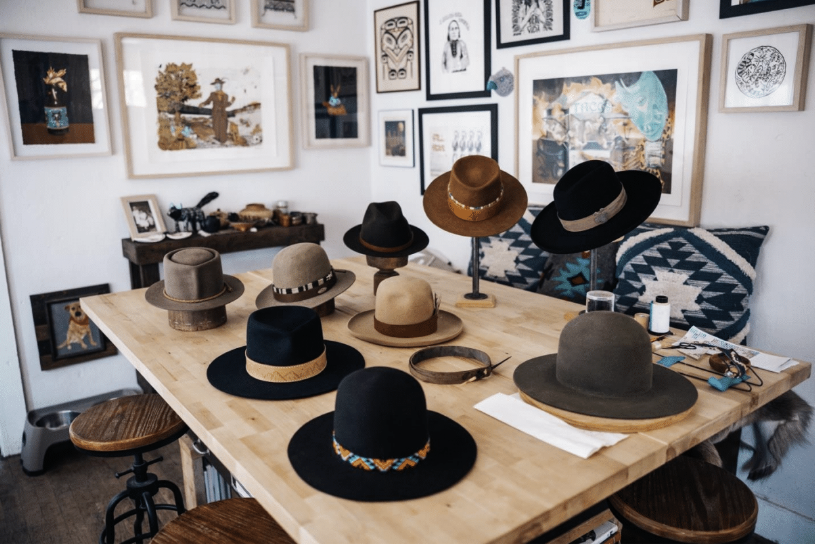
Rather than hide her identity after discovering her Indigenous roots on her mother’s side, Gutierrez-Krapp embraced her family history and now incorporates it into her work.
With open crowns, handmade beadwork, and repurposed vintage beaver felts, her hats reflect both her heritage and her love of the Southwest. Designs often feature cacti, traditional blankets, saddles, and mountain landscapes.
Gutierrez-Krapp operated her first storefront on Montana Avenue after opening in 2020 and later moved to Alameda Avenue in 2024. However, after receiving a cancer diagnosis, she was forced to close the storefront and has been working from her home studio since February.
“When I feel really down, tired, and overwhelmed, I’ll force myself to go to the studio, and within ten minutes, I forget how bad I was feeling,” she said. “I think it’s all the touching and shaping that I get lost in. Even when I’m too tired for that, I can work on beadwork, which feels like meditation because I can rest while I work.”
“It’s nice to be working. It’s not like I can get another job because I can’t work more than three hours at a time. I’ve learned a lot about living in the present and not worrying so much about the future.”
While undergoing treatment, she continues to fulfill custom orders and offers in-person consultations to ensure every hat is both literally and figuratively the perfect fit.
“I make everything to order, so part of the client goes into how the hat looks,” she said. “They choose the band and style. When they try it on, of course I want it to fit well, but I also want them to feel like it’s part of them.”
Her work has attracted customers from around the world, including New Zealand, where one customer requested a unique custom design.
“She was Indigenous to New Zealand and Māori,” Gutierrez-Krapp said. “She wanted me to bead embroider a boat on the back of the hat with a basic compass so she could use it in school to teach children about sailing.”
Not only is Gutierrez-Krapp highly skilled at her craft, but she is also one of the few women working in the custom hat-making industry. Through her work, she continues to uplift other women artists while creating pieces that celebrate culture, identity, and self-expression.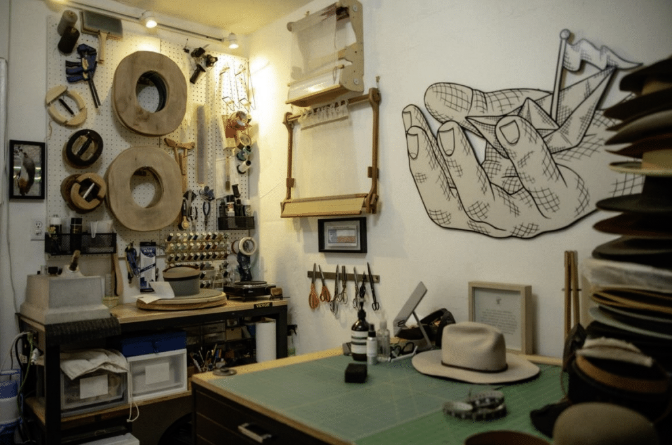
“Hat making was very much a male-dominated field,” she said. “When I first started, there were reportedly only eight hat makers in the United States. It’s slowly gained popularity, and I’ve seen more women embrace the craft and make it their own. When I’m making hats, I’m also incorporating pieces created by other local women. My friend Becca is a weaver and has created woven pieces for me, and my friend Claudia is a jeweler who has made several custom pieces as well.”
Although her brick-and-mortar location has closed, Gutierrez-Krapp remains optimistic about the future of Aghaa’ Hat Co. and has plans for new opportunities.
“I was planning to reopen in October, but because of my treatment, I can’t commit to that right now,” she said. “Instead, my plan is to create a pop-up shop. I have a shipping container near Paradox and Old Sheepdog by Lincoln Park, and the idea is to use the front portion of it as a retail space.”
Through both the challenges and victories she has faced, Gutierrez-Krapp has found comfort in her work and continues creating while fighting cancer. Her hats are more than accessories—they are handcrafted pieces of art designed to last for generations. Each made-to-order creation combines a customer’s personal story with the beauty of the desert landscape and the rich cultural heritage that inspires her work.
By blending craftsmanship, culture, and individuality, Gutierrez-Krapp has built more than a business. She has created a meaningful way for people to express who they are while honoring the traditions and stories that helped shape her own journey.