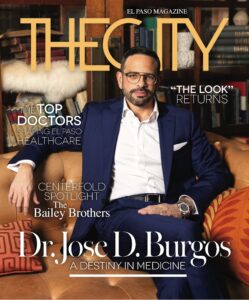
Dr. Jose D. Burgos turns a childhood passion into purpose
It’s rare for someone to follow a path that traces all the way back to childhood. Most people discover their calling through trial, error and time. But for Dr. Jose D. Burgos, the idea of becoming a physician took root early. He recalls being shaped by everything around him: his family, the rhythm of daily life and the lessons he absorbed from the experiences of others.
At 6 years old, Burgos fell gravely ill with a severe infection that left him dangerously dehydrated, a story his mother repeated to him throughout his life. As his condition worsened, the medical team had all but given up. He was “baptized in articulo mortis,” a Latin phrase meaning “at the point of death.”
In that moment, his godfather, a physician, stepped in. When no one else could place an IV because of the dehydration, he managed the near-impossible and stabilized him, ultimately saving his life.
The experience forever changed how Burgos saw physicians. “Growing up with that story changed the way I saw physicians,” he says. “To me, they were almost like superheroes, not because they were perfect, but because they could enter the most fragile moments of a person’s life and change the outcome.”
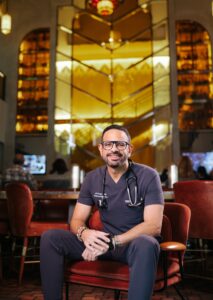
He was also inspired by his great-grandfather, Ángel Hernández, a self-taught apothecary and alchemist who owned the only pharmacy in Ciénaga de Oro, Colombia. “He was one of the people my father admired and loved the most. I grew up hearing stories about this brilliant man who served his community at a time when physicians were not easily available, especially in rural areas. So, for me, medicine was never just a career choice. It was connected to family, survival, service and community.”
In time, a defining moment confirmed for Burgos that he had chosen the right path. Shortly after graduating from medical school, he began his social service in rural Venezuela. One day, a mother went into labor just as the local clinic lost power, forcing an urgent transfer to the nearest maternity hospital, 45 minutes away. That hospital was overwhelmed, so they were redirected to another facility, another 30 minutes down the road.
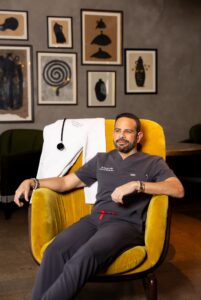
The baby didn’t wait. Burgos delivered the child in the back of the ambulance, his first delivery as a physician. The moment became even more meaningful when the mother named her baby after him, a gesture that struck him deeply because of his own birth story.
“My mother was being transported from a small town in Venezuela to a hospital in Valencia, about two hours away. She also could not wait, and I was born in Puerto Cabello.”
The Venezuelan native adds, “So, in many ways, that moment felt full circle. I had been born in an ambulance, and years later, as a physician, I delivered a baby in an ambulance. It was emotional, beautiful, and it confirmed that I was exactly where I was supposed to be.”
Burgos earned his medical degree from Universidad de Carabobo in Venezuela, followed by a postdoctoral fellowship in stem cell therapy at the University of South Florida in Tampa. He completed his residency in internal medicine at Texas Tech University Health Sciences Center in El Paso. He also holds a Master of Business Administration from UTEP and a Master of Science in palliative medicine from the University of Colorado, and he is completing a fellowship in palliative care medicine at the University of Colorado.
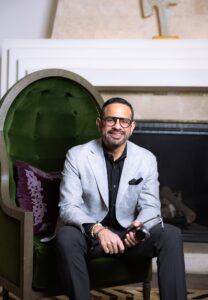
Today, Burgos is pioneering the area of specialized care known as palliative medicine.
“Working in hospitals, I began to notice a painful pattern. Many patients with chronic and serious illnesses would return again and again, sometimes three or four times in a single month. At some point, you realize that many of them are not truly living. They are suffering. There is no comfort, no dignity, and often no clear conversation about what is really happening. In medicine, we are trained to treat aggressively. We treat conditions, symptoms, lab results, scans, and complications. But sometimes we need to step back and ask a more human question: What are we trying to accomplish? If we cannot reverse the illness, then we still have a duty to relieve suffering, protect dignity, and be honest about expectations.”
Another personal experience shaped Burgos while he cared for a relative with advanced cancer.
“His cancer was very advanced, yet chemotherapy was started to try to prolong his life. Theoretically, it might have given him a few more months, but his quality of life became miserable. He was suffering so much that he begged me to do something to end his life sooner. That experience changed me. It made me understand that prolonging life should not always be the only goal. The goal should be to preserve quality of life. A longer life without quality can become suffering, not only for the patient, but also for the family.”
“Sometimes, as physicians, we are afraid to tell patients and families that enough is enough. We feel that if we stop aggressive treatment, we have failed. But that is not failure. It is a reframing of care. When a disease reaches a point where we cannot dramatically change the outcome, we can still change the experience. We can focus on comfort, dignity, honesty and peace. That is why I fell in love with palliative medicine.”
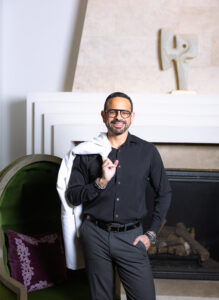
Hospice, which is part of palliative care, focuses on dignity at the end of life.
“We celebrate births, but we often run away from death, even though death is the only certainty we all share. Over the years, I have practiced this specialty with two basic principles: Nobody should die alone, and nobody should die in pain.”
“My approach is to care for every patient with empathy, respect, honesty, and the commitment to go above and beyond when they need me most. I saw chronic illness very closely in my own family. My grandmother had severe rheumatoid arthritis at a time when we did not have the biologic treatments and advanced medications available today. I watched her lose weight, suffer, and decline.”
He also recalls spending long afternoons in waiting rooms with his mother, sisters and other family members while waiting for care.
“Those experiences stayed with me,” he says. “When someone is already dealing with pain, fear, illness, or uncertainty, the health care system should not add more suffering through long waits, poor communication, rude staff, or unapproachable physicians.”
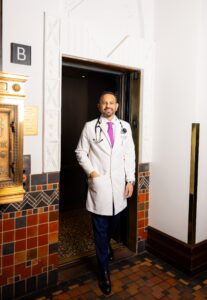
He adds, “I have always believed that a bad person cannot be a truly good physician. Clinical knowledge matters, of course. But compassion is what pushes a physician to keep searching, keep learning, and keep fighting for the patient.”
What he enjoys most about practicing in El Paso is watching the community evolve.
“I came to El Paso for training, and I remember doing my residency at Thomason Hospital, when it was essentially one main tower. To see what it has become as University Medical Center of El Paso has been inspiring. That growth motivated me to do more for the community.”
That inspiration pushed him to expand access to care throughout the city.
“That is part of the reason behind my work with Ucare Urgent Care clinics, which help increase access to medical care; Proactive and El Paso Medical Research, which bring cutting-edge therapies, technology, and research opportunities to the community; Palliative Coalition, which focuses on comprehensive care for patients and families facing serious, chronic, or terminal illness; and MobileMed, which is especially meaningful to me because it brings medical services directly to patients in nursing homes, assisted living facilities, foster homes, rehabilitation centers, long-term acute care facilities, post-acute care settings, and even into patients’ homes.”
“My goal has always been to improve access to medical services in this community. Even though I was not born in El Paso, my children were born and raised here. My parents now live here and enjoy the services, culture, and life of this city. So improving health care in El Paso is deeply personal to me. I want my family to have access to better care, but I also want that for everyone around me. I enjoy building things that make the community stronger, healthier, and better.”
Burgos says one of the most serious health threats he sees today is misinformation.
“We are living in a time when many people get medical advice from influencers, social media personalities, or individuals with no formal medical training. That is not only unfortunate, it can be dangerous.”
He stresses that health decisions should be grounded in “science, evidence, and professionals who have spent years studying, training, treating patients, and accepting responsibility for the consequences of medical decisions.” When misinformation spreads, he adds, clinicians are often left to manage the fallout. “That is why education is so important.”
He frequently treats diabetes, obesity, cancer, heart disease and complications related to alcohol use.
“Many of these conditions can be prevented, delayed, or detected earlier through education, lifestyle changes, screening, and access to primary care,” he says. “For me, the challenge is not only treating disease. The challenge is helping people understand how to prevent it before it changes their lives.”
Another major issue Burgos sees in El Paso is excessive alcohol use.
“We are seeing young people with serious liver disease, and many of these cases are tied to alcohol. Alcohol use is not only a physical health issue; very often, it is connected to mental health. Addiction is rarely just about the substance. It is often rooted in emotional pain, trauma, anxiety, depression, or untreated mental health needs. These are complex issues, but they can be addressed if we approach them honestly, compassionately, and without judgment.”
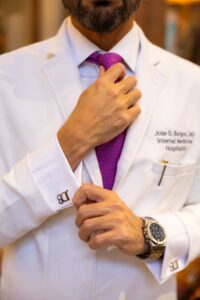
Burgos offers four simple habits to improve overall health. He says maintaining a healthy weight is essential, not for appearance, but for reducing inflammation, lowering chronic disease risk, protecting mobility and preserving long-term health. He also emphasizes adequate sleep, noting that it affects metabolism, mood, memory, immune function, stress and recovery. Many people, he says, underestimate how much poor sleep harms their health.
He urges people to eliminate toxic habits, especially smoking, excessive alcohol use and recreational drug use. Finally, he stresses the importance of mental health. When someone is anxious, depressed or overwhelmed, he says, it becomes harder to eat well, exercise, sleep, avoid alcohol and make healthy decisions. Health, he adds, is built through small, consistent choices, not overnight transformation, but a willingness to start.
Burgos says stress can erode both physical and mental health, contributing to anxiety, depression, insomnia, weight gain, emotional eating, high blood pressure, fatigue and unhealthy coping habits such as excessive drinking, smoking or drug use. It can strain relationships, affect work performance and impair decision-making. Over time, he notes, chronic stress increases the risk of long-term disease.
He emphasizes identifying the source of stress, often with a therapist, as the first step.
“We are living in a time when we understand more than ever that therapy is not weakness, it is a tool,” he says.
He also stresses boundaries, trusted conversations, regular exercise and intentional moments to disconnect. Physical activity, he adds, is one of the most effective ways to release tension and regulate emotions. The goal is not to eliminate stress, but rather for people to understand it, manage it and keep it from taking over their lives.
On preventive care, Burgos says many chronic disease risks can be identified early. Prevention, he notes, begins in childhood with vaccination, nutrition, emotional development, physical activity and consistent routines. In young adulthood, he recommends establishing care with a primary provider, understanding family history and avoiding harmful long-term habits. In middle age, he stresses screenings for blood pressure, cholesterol, diabetes, cancer and weight management. Later in life, prevention focuses on maintaining function, independence and quality of life. Mental health, he adds, is part of prevention, noting that emotional strain can eventually affect physical health.
“Preventive care is not only about living longer. It is about living better.”
Regarding modern medicine, Burgos says artificial intelligence is reshaping health care quickly. He believes the real risk is not AI itself, but allowing powerful systems to remove human responsibility from care. Used appropriately, he says AI can improve efficiency, reduce administrative burden, identify patterns and expand access to information, freeing physicians to spend more time with patients. But he cautions that medicine cannot become transactional. Patients need more than data, he says; they need judgment, compassion, accountability and human connection.
“AI should help physicians become better physicians. It should not replace the heart of medicine.”
Burgos is also a strong supporter of telemedicine and modern communication tools, including text-based options when appropriate. He says medicine must adapt to how people communicate today, especially younger generations who prefer shorter, more flexible interactions. Telemedicine, he notes, works well for minor concerns, follow-ups, medication discussions, reviewing results and helping patients with transportation or scheduling barriers.
Still, he emphasizes that it cannot replace the physical exam. Some situations, he says, require in-person evaluation, including listening to lungs, assessing swelling or pain, performing tests or completing procedures that can only be done face to face.
“Telemedicine is not a replacement for traditional medicine. It is an extension of it.”
Outside of medicine, Burgos says his greatest joy is spending time with his children and watching them grow. He values family vacations because he sees time with them, and with his parents, as limited and deeply meaningful. He admits one of his biggest challenges is finding enough time for everything he wants to do, noting that each day is an opportunity to live with intention.
Burgos says his children motivate him most. When they ask what they should become, he tells them to pursue happiness and purpose. Purpose, he explains, is what helps people push through hard moments and keep moving forward. He encourages them to find a purpose tied to their community, noting that people are inherently connected and have a responsibility to make their community better every day.
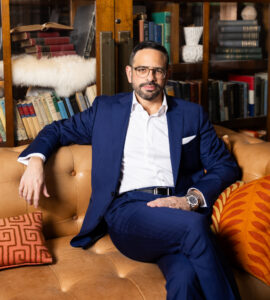
Quick hits from Burgos, in his own words:
Coffee or tea?
Coffee all the way. A latte with whole milk. If it is from 787 Coffee, even better.
Early bird or night owl?
A night owl forced to be an early bird.
One book, podcast or habit you recommend to everyone?
The book “Die With Zero” by Bill Perkins. It gives a very powerful perspective on time, money, experiences and how we choose to live.
A piece of advice you give patients that also applies to your own life?
Take that trip.
Say “I love you.”
Be thankful.
Do not take everything personally.
Everyone who crosses your path is fighting his or her own battle.
All in all, Burgos says it best: “There are no shortcuts in medicine. Every medication, supplement, procedure, or treatment should be evaluated through the lens of risk versus benefit. At the same time, life is short. Be present. Time is our most valuable asset. Use it wisely. Protect it. Spend it with the people you love and on the things that truly matter.”