Meet Citlali Delgado: New Border Art Resident
An older woman with a bed of cacti as her hair. A Texas license plate filled with references to Indigenous identity and femicides in Ciudad Juárez. A giant little girl sitting on the border wall, crushing it with her weight as familiar borderland figures parade along Loop 375 while the billboard next to them reads, “Watch for unexpected pedestrians.” These images offer a glimpse into the layered, border-conscious work of the El Paso Community Foundation’s new Border Art resident, 22-year-old Citlali Delgado.
The El Paso Community Foundation selected Delgado for the Border Art Residency, a four-month program that provides artists with housing and studio space to focus on creating new work. Artists Becky Hendrick and Willie Ray Parish established the program in 1997 to help artists like Delgado create freely.
Although Delgado always had the talent to draw, it wasn’t until quarantine that she explored what her talent could become.
“I didn’t really get into [art] fully until COVID happened,” Delgado said. “I had always been a student athlete, but everything was shut down. It really forced me to be around the house and look at my surroundings. My little sister painted at the time, and I just thought to myself, ‘I could do that.’”
As a sports fan and artist, Delgado learned to combine her two passions and created content on TikTok, leading her to gain 20,000 followers on the platform.
“I got out of my shell and mixed my love for sports with something I was good at, and started painting and drawing football players,” she said. “People would tag the NFL players and the players would actually like, comment, and repost. And so that’s what kick-started it off, but I would say once that was over and we were back to ‘real life,’ my art developed into something more specific to me.”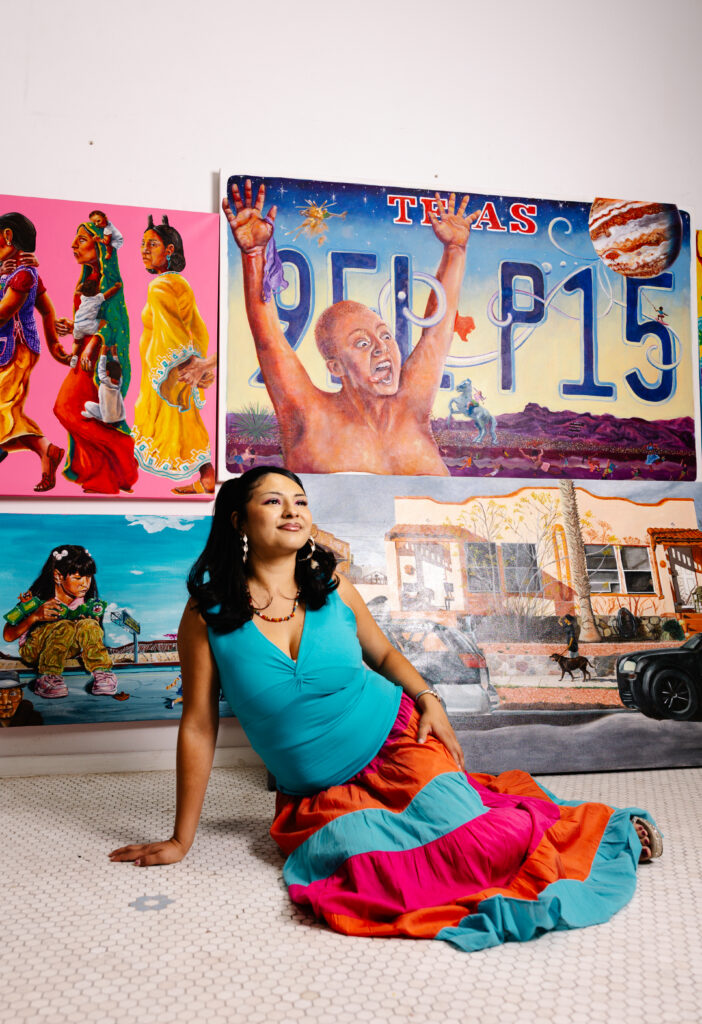
Delgado earned her Bachelor of Fine Arts from New Mexico State University and was a recipient of a Taco Bell Foundation scholarship. During her time at the university, Delgado strengthened her skills and homed in on her style.
“Even though football was a passion I enjoyed watching, the people that I was watching and cheering for do not represent me as a woman, a woman of color, and a woman of the borderlands,” she said.
Delgado hails from a lineage of artists. Her grandmother was a seamstress, her father is a printmaker, muralist and painter, and her uncle is a tattoo and makeup artist. Delgado said growing up around that creativity helped shape her path as an artist.
“I grew up going to exhibitions, community events, and protests,” she said. “Even though I didn’t really care for it as a little girl, all of that was a seed planted in me that has really bloomed today. You don’t think about those things as a child, but now as a grown woman, I’m learning to understand the things that I was told like to be ‘brown and proud’ and to support farm workers.”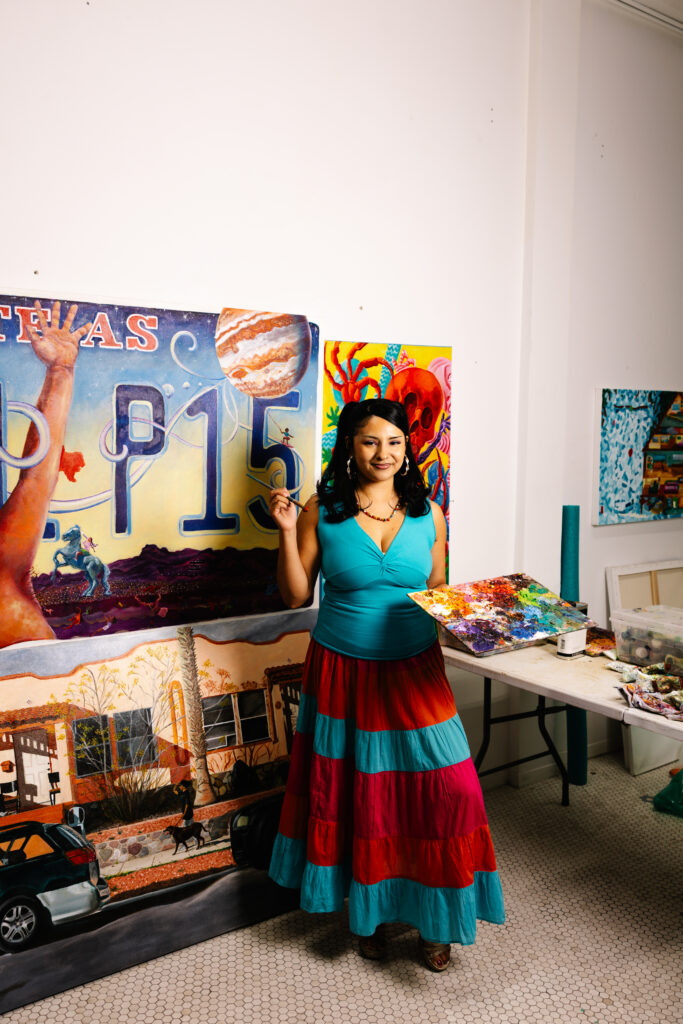
Delgado’s work typically highlights feminism and women of the borderland, telling stories of their struggles and progress over time.
“I think everything is so political,” she said. “I tied those historical things that I’ve learned to something more specific, like what it means for me to be an Indigenous woman nowadays and what it took for me to be here. There’s a clear representation of the people that are being rendered. They’re typically women and again, women of color. Everything that has to do with the desert, religion, freedom, liberation, and where we stand today, all of that is political. Some people call my work didactic, and I feel that happens because I do have a lot of references to history. I reference those happenings in my work, and I tie them to what’s currently happening.”
One of the pieces Delgado is working on, “Metamorphosis,” depicts an Indigenous woman through time in a “March of Progress” evolutionary lineup. It begins with La Malinche, an Indigenous woman who was sold to Hernán Cortés and later became his translator.
“She was one of many women sold, but she is a very polarizing figure in Mexican history because people blame her for the colonizers taking over Mexico and some parts of the U.S. because she helped translate,” she said. “As a woman, I believe she did what she had to do to survive. [At the end] I have this woman who’s dressed in a miniskirt with cute clothes and kitten heels because she can. Instead of children, she has a dog. She’s looking back and thinking about the women who have been in her past that have helped pave the path to where she is today. Next to her is another foot, representing the women of the future.”
Delgado’s residency includes several projects, including an art installation and historical portrait at NMSU, and an upcoming museum show in Las Cruces.
“I’ll be doing [the installation] on parachute cloth,” she said. “I’ll get to work on these walls, and that’s why it’s really great to have a big studio for larger-scale works. I’m also doing a historical portrait for NMSU for Fabiola Cabeza de Vaca because they’re going to name a conference room after that historical figure.”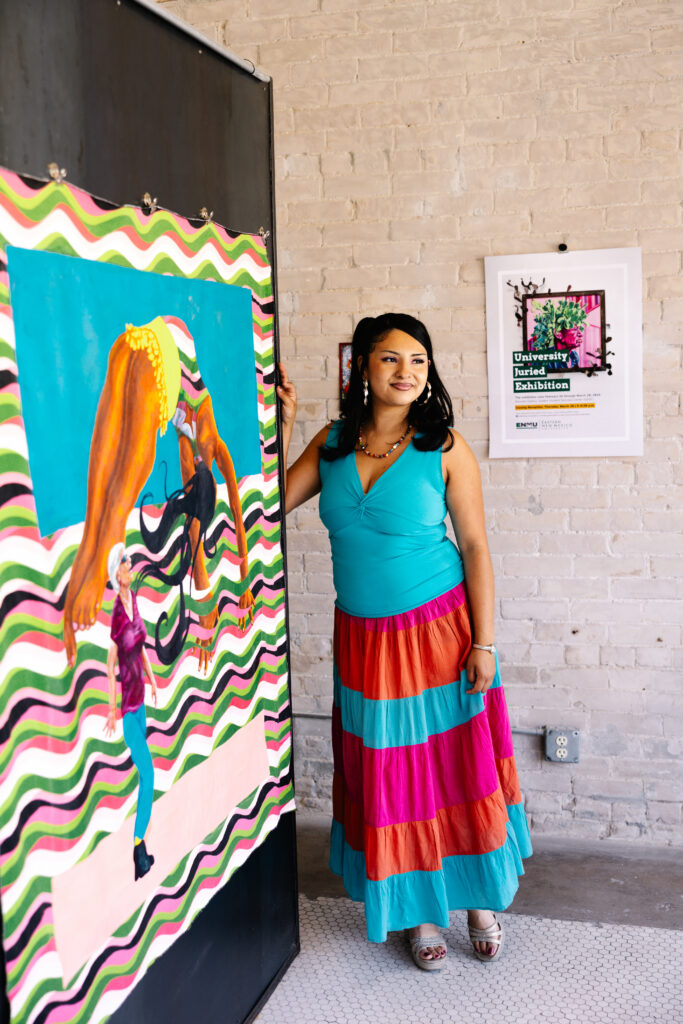
Delgado’s four-month residency will conclude in August with a closing exhibition, open to the public, featuring the work she created during the program.
Before her residency ends, the El Paso Community Foundation will host a ‘Meet the Artist’ event for the residency program on June 24, 2026
“I’m grateful to have gotten this residency,” she said. “Even if I do leave El Paso for grad school in a few years, I will always come back. That would be the plan, to relay all the knowledge that I’ve gotten everywhere else and bring it back to the community.”